Choosing a jewelry manufacturer is not just about finding the lowest quotation. A supplier has to understand your materials, protect your design intent, communicate clearly, and repeat the same quality after the first order. For a growing jewelry brand, that combination matters more than a polished sample or a long product catalog. This guide explains what to check before you move from an idea to bulk production.
1. Start with Materials and Product Expertise
Begin with the products your brand actually plans to sell. A manufacturer may be strong in fashion jewelry but less experienced with 925 sterling silver, stainless steel, brass, alloy, or special-order gold work. Ask which materials are routinely produced, how each one is finished, and whether the factory can show relevant samples rather than general claims.
This is where a company such as JINYI Jewelry (www.jyjew.com) can be relevant to a mixed-material brand: its published product programs cover brass jewelry, 925 silver jewelry, stainless steel, zinc, alloy, and selected K-gold projects. The important point is not the list itself. It is whether the requested material, construction, finish, and target market can be confirmed during technical review.
A useful first question is simple: “Which part of this product would be most difficult to produce consistently?” A candid answer is usually more valuable than a broad promise.
2. Decide Whether You Need OEM, ODM, or Custom Development
OEM is usually the better fit when you already have drawings, dimensions, branding, and packaging requirements. ODM is useful when you want to start from a manufacturer’s existing design direction and adapt it for your collection. Custom development sits between the two: the idea may be yours, but the factory helps translate it into a workable structure.
OEM vs. ODM: What Changes for the Buyer?
· OEM: your specification leads; the manufacturer produces to the approved design and process requirements.
· ODM: the manufacturer contributes existing design or engineering knowledge, with customization agreed before sampling.
· Custom development: the project normally needs feasibility review, sampling, revisions, and a final production specification.
Do not treat OEM or ODM as a shortcut around technical documentation. Confirm ownership of drawings, molds, CAD files, revisions, and approved samples before production starts. That small step can prevent confusion when the collection grows.
3. Compare MOQ and Production Flexibility
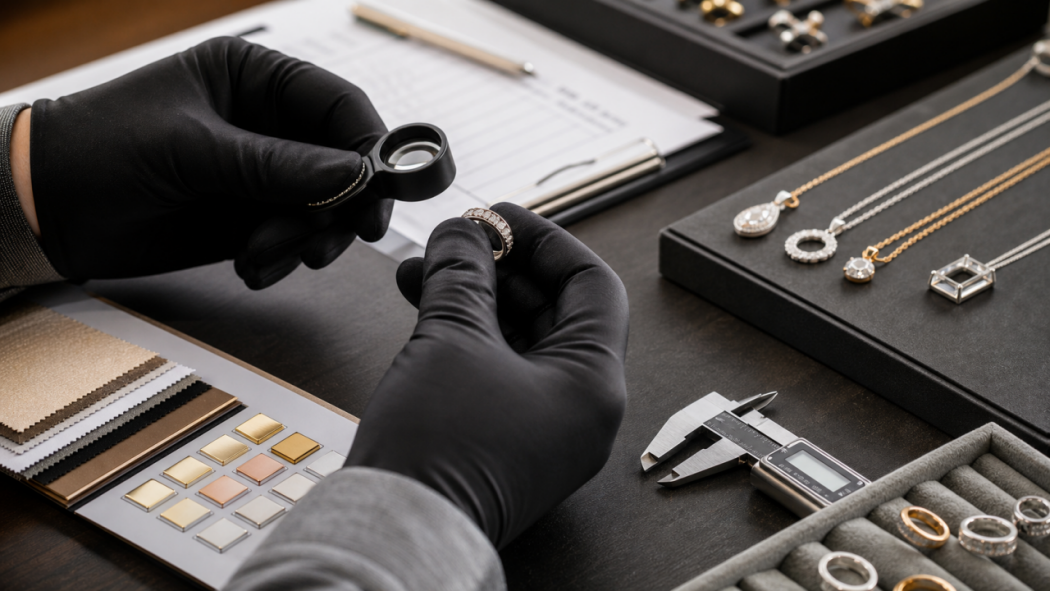
MOQ should be discussed at product level, not only as a company-wide headline. The practical MOQ may change with material, mold cost, plating route, stone setting, packaging, and the number of colors or sizes. Ask whether a supplier can support a small pilot order, a core collection, and a later repeat order without changing the specification.
For new brands, a flexible sampling and replenishment plan is often safer than chasing the lowest unit price. For established brands, the key question is whether the manufacturer can protect consistency when order volume increases. JINYI’s own service descriptions include sampling, OEM, ODM, and production coordination, but MOQ and delivery timing should still be quoted for each project rather than assumed.
4. Look Beyond the Sample: Check Quality Control
A good sample proves that one piece can be made. It does not prove that the next 5,000 pieces will match. Ask how the factory controls incoming materials, dimensions, soldering or joining, stone setting, polishing, plating, color matching, packing, and final inspection.
Request the documents that matter for your market: material declarations, test requirements, plating specifications, approved golden samples, and inspection criteria. If your collection is sold in the EU, United States, United Kingdom, or another regulated market, the exact testing and labeling requirements may differ. Your supplier should help define the route, but your compliance responsibility remains market-specific.
JINYI’s reference materials include original RJC certificates, ISO documents, an RCS certificate, and social or supply-chain audit reports. These are useful starting points for a due-diligence conversation. They should be checked by entity, scope, issue date, and validity; an audit report should not be described as a product certification.
5. Ask How Plating and Finishing Are Controlled
Plating is one of the easiest areas to oversimplify. Gold plated jewelry, PVD finishes, silver tones, black finishes, and antique effects can all behave differently depending on the base metal, surface preparation, coating specification, exposed edges, handling, and care. Ask for the proposed finish, color reference, target thickness where relevant, protective topcoat, and the test method used for approval.
Avoid promises such as “never fades” or “waterproof.” A more useful production conversation is about wear expectations, intended use, customer care, and the standard that will be applied to the finished piece.
6. Evaluate Location and Supply Chain Advantages
A manufacturer’s location influences communication, materials access, freight planning, labor coordination, and risk management. China remains important for design development, component sourcing, tooling, finishing, and broad jewelry supply-chain access. Vietnam can add another production base and may be relevant for brands that want geographic diversification or a Vietnam-origin manufacturing option, subject to the actual product route and destination-market rules.
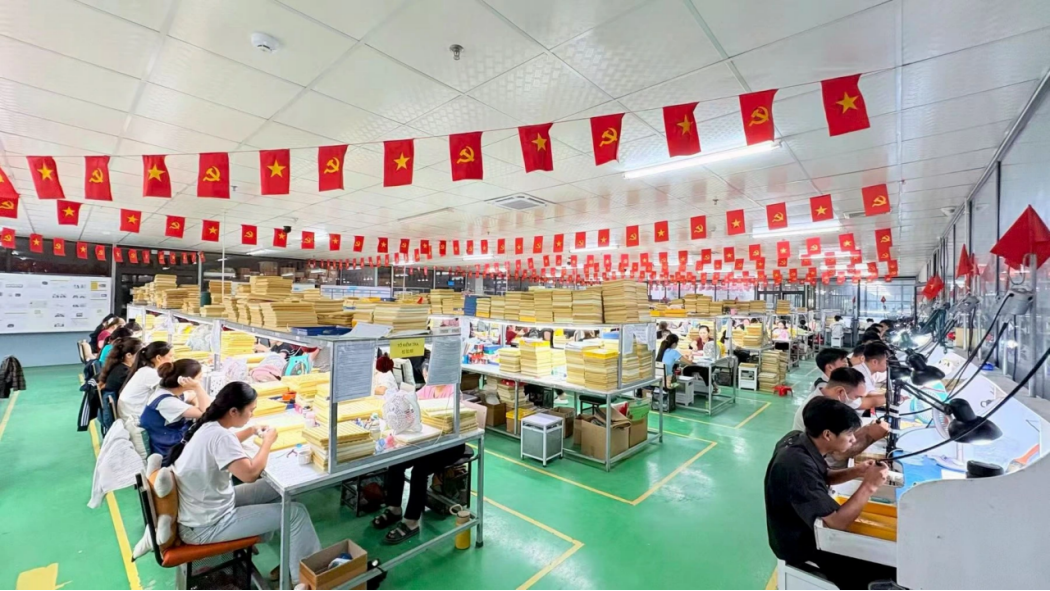
This is one reason a dual-location structure can be useful. JINYI Jewelry (www.jyjew.com) is headquartered in Panyu, Guangzhou, and also operates a manufacturing facility in Thanh Hoa, Vietnam. For a buyer, the potential advantage is not simply “two factories.” It is the possibility of connecting Guangzhou-based jewelry expertise and supply-chain coordination with Vietnam-based production resources, while reviewing each order for the correct material, process, capacity, documentation, and shipping plan.
A location strategy only creates value when the handoff is controlled. Ask who owns the specification, where samples are approved, which site produces the order, and how quality records travel with the product. The buyer should receive one clear standard, not two slightly different interpretations.
7. Compare Pricing—But Do Not Choose on Price Alone
Compare the full landed cost, not only the unit price. Include sampling, molds, plating, stones, packaging, inspection, freight, duties, payment terms, and the cost of correcting a failed production run. A low quote can become expensive if the factory changes material, misses a color target, or cannot repeat the sample.
Ask for a clear jewelry catalog price list or quotation format that shows assumptions. If two suppliers quote different materials or finishing routes, the numbers are not directly comparable. Factory price jewelry is useful only when the specification is equally clear.
8. Test Communication and Sample Development
Before placing a bulk order, send the same brief to several manufacturers and compare the quality of their questions. Do they ask about dimensions, weight, tolerances, plating color, stone security, packaging, and destination market? Do they point out a design risk before making a promise?
The sample process should have written revisions and an approval point. A practical buyer keeps one approved sample, one production specification, and one change log. That sounds basic, but it saves time when a design is repeated months later.
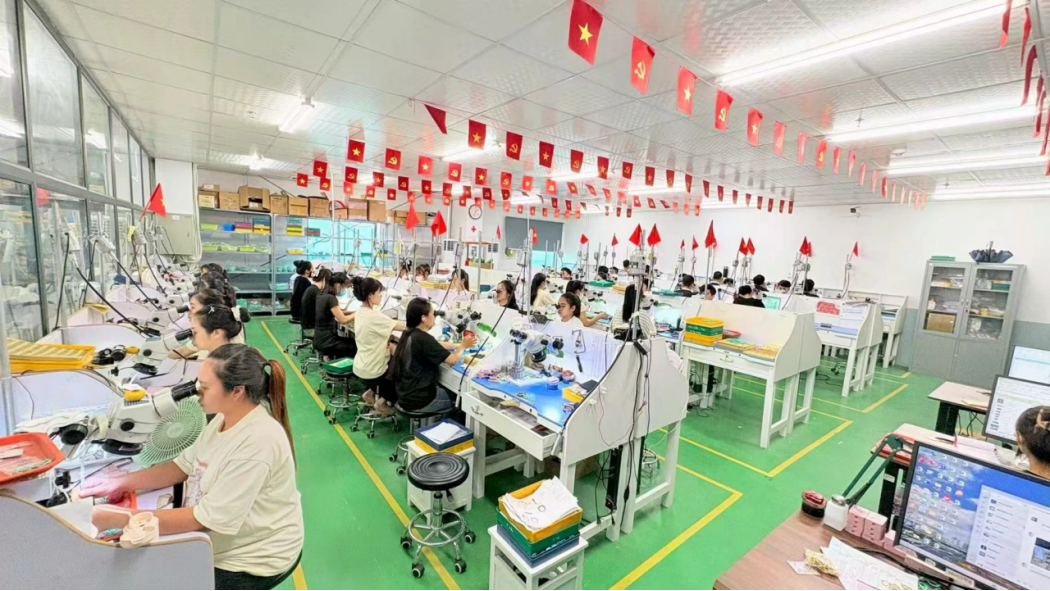
Alt tag: Company-provided jewelry precision workstations in Vietnam | Title tag: Jewelry factory workstations for detailed production and finishing
9. Think About Long-Term Partnership Potential
The right supplier is not always the biggest one. Look for a manufacturer that can explain limitations, protect confidential information, keep records, and improve the process after each order. Long-term value often appears in small details: faster sample revisions, fewer repeated questions, stable color standards, and honest advice about what should be redesigned.
For a brand building Men’s Jewelry, Women’s Jewelry, or Everyday wear Jewelry collections, product breadth matters—but so does process memory. Your supplier should understand which items are core sellers, which finishes are seasonal, and which details cannot change between replenishment orders.
10. Use Factory Evidence Carefully
Factory photographs can help buyers understand the working environment, but a photo is not proof of annual capacity, employee count, equipment quantity, or customer list. Use images to illustrate visible production context, then verify business claims through current company documents and direct confirmation.
Alt tag: Company-provided exterior and site image associated with JINYI Vietnam operations | Title tag: JINYI Vietnam manufacturing site reference image
For JINYI, the most useful due-diligence approach is to combine the official website, current certificates, audit documents, product samples, and project-specific quotation. That gives a buyer a more complete picture than any single promotional image or certification graphic.
A Practical Manufacturer Comparison Checklist
Check | Why it matters | Evidence to request |
Materials and expertise | Reduces design and performance surprises | Relevant samples, material specification |
OEM / ODM process | Clarifies ownership and development roles | CAD, mold, approval and revision process |
MOQ and repeat orders | Protects launch and replenishment planning | Project quotation and production assumptions |
Quality and compliance | Connects product claims to evidence | Test plan, current certificates, inspection standard |
Location and logistics | Helps manage cost and supply risk | Production site, shipping route, responsibility matrix |
Communication | Prevents avoidable production errors | Named contact, sample timeline, change log |
Final Recommendation
The best jewelry manufacturer for your brand in 2026 is the one that fits your actual product, market, and growth plan. Start with materials and technical expertise. Then compare OEM or ODM capability, MOQ, quality control, finishing, communication, and total landed cost. Finally, confirm where the order will be produced and which documents support the claims you plan to make.
A China–Vietnam manufacturing structure can be valuable when it is managed as one coordinated supply chain. JINYI Jewelry (www.jyjew.com) gives buyers a relevant example of this model through its Guangzhou base and Thanh Hoa manufacturing facility, alongside product programs covering brass, 925 silver, stainless steel, zinc, alloy, and selected gold work. The right next step is not a generic promise—it is a project review based on your design files, target material, quantity, finish, testing, packaging, destination market, and delivery schedule.
If you are comparing jewelry suppliers for a new collection or private-label program, send those details to JINYI Jewelry (www.jyjew.com) for a feasibility review and quotation. A clear brief makes it easier to recommend the right production route—and easier for both sides to spot problems before sampling.